Why projects are the new operating system of the economy — and what that means for people and organizations.
Antonio Nieto-Rodriguez nailed it back in 2021 in the Harvard Business Review: “The Project Economy Has Arrived.” Products, change initiatives, regulation, even sustainability and social innovation — all of this is now most often delivered through projects. That means projects are no longer the exception alongside the day-to-day business; they are the day-to-day business.
According to PMI, by 2027 around 88 million people worldwide will work in project-oriented roles. The annual value contribution of that work: an estimated 20 trillion US dollars. Projects are a major economic engine and a key driver of growth, contributing significantly to both organizational and economic success — and with them, the people who deliver them successfully.
What this means in practice
For organizations this means: the ability to bring the right people, at the right time, into the right project, with the necessary capacity, becomes a core competence. Not as an HR topic, but as a strategic success factor. Those who have anchored this capability sustainably in their organization can deliver projects more successfully — and crucially also on time and on budget. Those who fail at this burn money, time, and motivation — and ultimately alienate employees through steadily growing frustration.
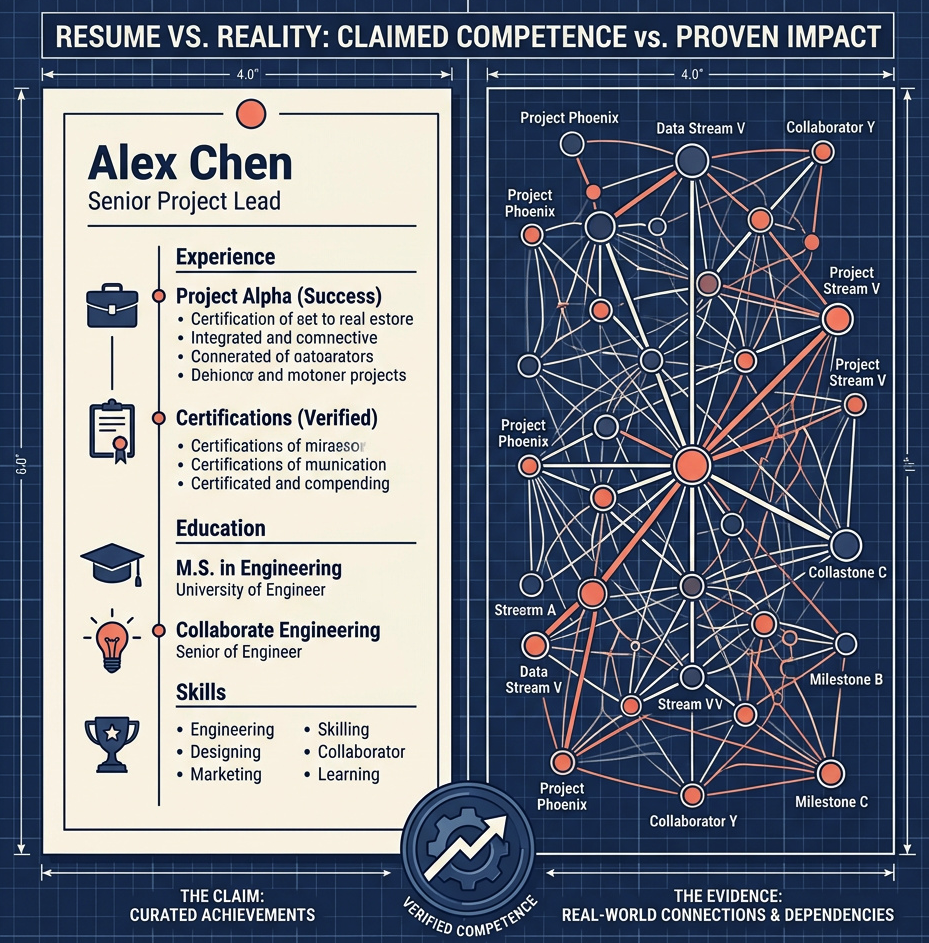
And for professionals, the perspective on the future is shifting too. The classical career path — entry, promotion, specialization — is giving way to a project-based career trajectory. What counts isn’t the title on the business card, but what someone has demonstrably delivered in concrete projects. Capabilities that are visible and reliable.
There are also enormous opportunities for professionals here: those who know what they can do and are aware of their strengths also know where they want to develop next and where they still have room to grow — and can use this purposefully for their professional and personal development. This is how experience-based capability becomes a success factor for both organizations and professionals — and a new currency of work.
The challenge
As described at the outset, most organizations have long been operating in the Project Economy — but the tools and instruments they rely on still come from the old world. Where capability management exists at all, it often happens in Excel; staffing decisions are based on personal contacts, CVs, and informal calls. Feedback on individuals and their contributions usually happens only once or twice a year — and even then mostly to satisfy an HR standard process, not to give professionals a genuinely useful tool for personal development. A patchwork that feels out of time and doesn’t really integrate or fit together.
In a project-centric world that thrives on adaptability, flexibility, creativity, capacity for innovation, and speed, what’s needed is a system that makes the fuel of “experience-based capability” visible across the organization — and therefore usable.
The Project Economy is here. The only question is: are we ready for it?